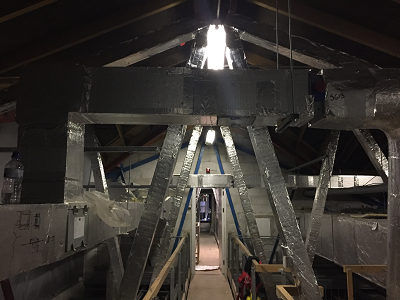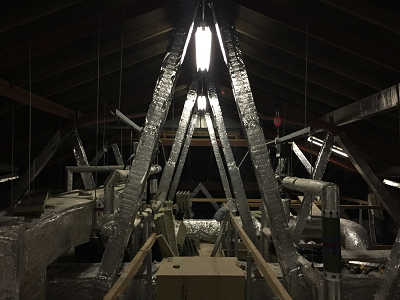


Structural steels are the most essential component of building construction; they are the load-bearing frames that support walls, floors and roofs. Given their importance, it is imperative that they are adequately protected so that, in the event of a fire, the building does not succumb to the high temperatures and collapse. Not only does this protect the occupants, allowing them sufficient time to evacuate the building, but it also protects the general public who may be in the vicinity of the building. When it comes to structural steel protection, there are several applications that can be provided to meet numerous requirements.
INTUMESCENT PAINT
Intumescent paint is a thin film application system that can be sprayed or hand-applied onto beams and columns to a required depth in order to provide up to two hours of passive fire protection. When subject to high temperatures the applied intumescent paint will expand up to fifty times its base thickness providing a protective insulating layer around the steel.
Typically, using a 'spray' method is the most efficient means of application as it allows fast dispersion and even distribution of material across all the structural steels. This means that a large quantity of steels can completed in a short space of time with minimal disruption to other trades. The even distribution also provides an show-quality appearance that can receive further finishes if required. Prior to receiving intumescent paint, the steels will need to be adequately protected using a compatible primer, and can receive specific top coats afterwards to protect it from a number of elements.

FIRE-RATED BOARD ENCASEMENT
Board Cladding
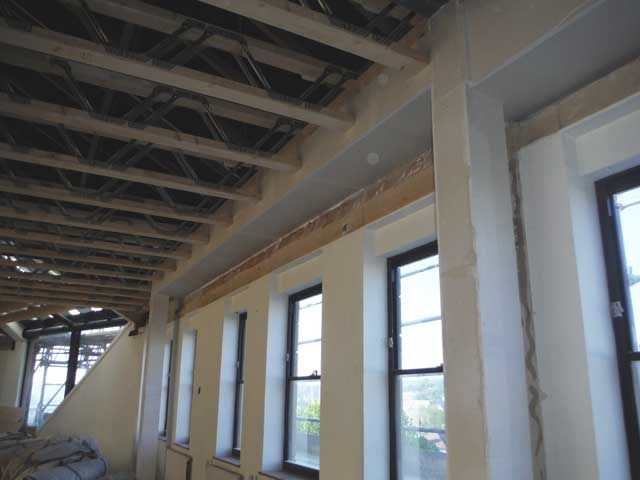
Fire-rated angle is mechanically fixed to the flange of the structural steels, and then an appropriately chosen fire protective board is cut and sufficiently fixed to the angle. Boards are affixed to each other and angles across the entire length of the steel (on all sides required), thus providing a full encasement and protecting it from fire. This cladding board can typically be used as a solid structure to affix metal stud and track to form partition walls. Depending on the material of the board and it's thickness, board cladding can achieve up to four hours fire resistance.




Mineral Fibre Board
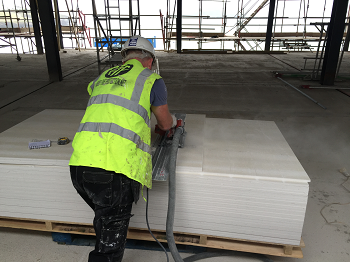
The aim of mineral fibre board is similar to that of Board Cladding - to provide a complete steel encasement across its entire length, but with a different installation process. The mineral board is cut to the webbing of the steel and these 'noggings' are glued with high temperature adhesive into place as a fixing point for the encasing boards. Boards are cut and affixed to the 'noggings' and each other with spiral screws to provide a full encasement around the steel protecting it from fire. The board is available plain or with a foil-faced finish. The latter often requires additional aluminium foil tape applied in order to conceal all edges and joints. This method of application can provide up to two hours of fire resistance.
Note:
Most boarding systems do not usually have a "show-finish" quality and are primarily installed for fire protection only. However, some cladding board encasement systems do have the added benefit of being able to receive further finishes such as plaster and paint, and (as previously mentioned) can be used as a fixing point for partition walls. The foil-faced finish on mineral boards does provide a more appealing aesthetic look when finished with aluminium foil tape compared to bare mineral finish.